
Patient Care
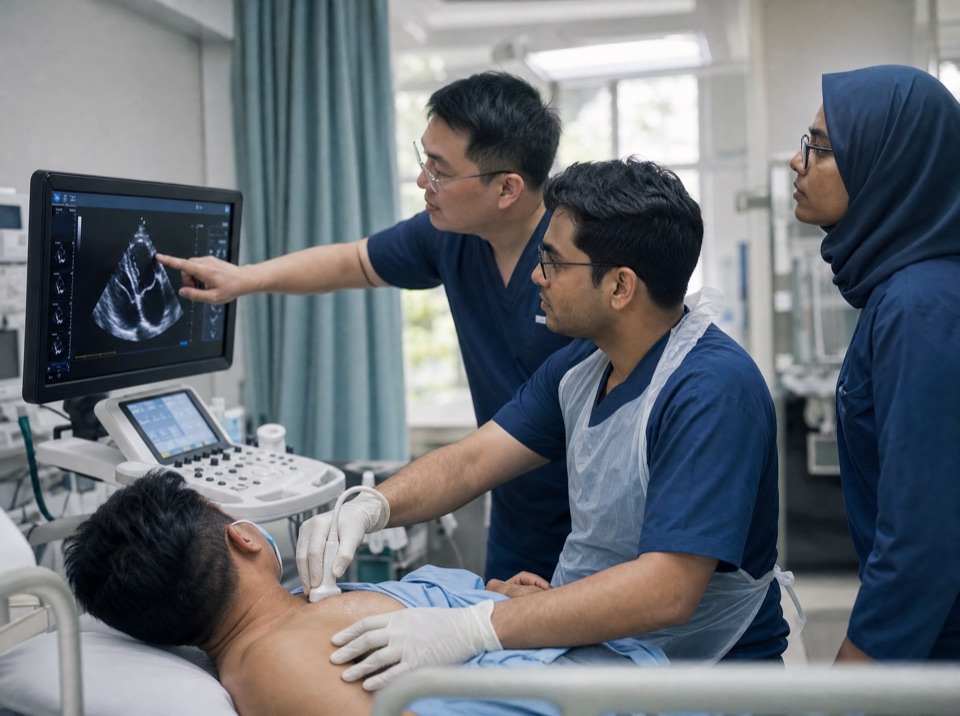
Safe, compassionate and evidence-based management of acute and chronic medical conditions.
A harmonised national framework for postgraduate training in Internal Medicine. Malaysia's public universities share one curriculum, common assessment standards and a commitment to excellent patient care.

The National Postgraduate Medical Curriculum (NPMC) is a Ministry of Higher Education initiative that harmonises postgraduate medical training across all Malaysian public universities. The Internal Medicine curriculum defines a common syllabus, shared entry and exit standards, and unified assessment for every Master of Medicine (Internal Medicine) trainee in the country.
Leadership of the NPMC Internal Medicine programme.
Every trainee progresses through a spiral curriculum that integrates clinical service, supervised learning and workplace-based assessment.
Safe, compassionate and evidence-based management of acute and chronic medical conditions.
Mastery of internal medicine and its subspecialties, applied to the Malaysian disease burden.
Effective, empathetic communication with patients, families and the healthcare team.
Integrity, accountability and ethical practice grounded in Malaysian societal values.
Lifelong learning, audit, research literacy and continuous improvement of one's practice.
Leadership, patient safety and effective work within the national healthcare system.



PUTRA CHARMS, the Clinical Holistic Assessment and Rotation Monitoring System, is a 360° workplace-based assessment platform for MMed Internal Medicine trainees. It is not an examination. It records how a trainee performs in day-to-day clinical work across every posting, as seen by supervisors and the people they work with.

IMQA is the qualifying assessment of the MMed Internal Medicine conjoint programme. It has two components: a theory component and a clinical component.
Three written papers test clinical knowledge and reasoning across Internal Medicine. The OBA papers and the EMQ paper are each standard set, then combined into a final mark out of 100.
To pass: a final mark of 50 or above out of 100.

Candidates are examined with patients across three parts. Every case and station is marked by two examiners, and the three parts add up to a clinical mark out of 100.



A candidate passes with a clinical mark of 50 or above out of 100, provided none of the conditions listed here applies. Any one of them is a fail, whatever the total.

The national TOT programme equips supervisors and examiners with the skills to teach, supervise and assess under the NPMC framework, so every trainee, in every university, is trained and judged to the same standard.
| Workshop | Date | Venue |
|---|---|---|
| Workshop dates are listed in Calendar & Events. | ||
Accredited TOT supervisors and trainers across Malaysia. Search by name, or narrow the list by subspeciality, state and hospital to find the trainers at your placement. Subspecialists also supervise General Internal Medicine.
Hospitals accredited for MMed Internal Medicine training, for General Internal Medicine, subspeciality training, or both. Filter by state, or open a hospital's supervisors.
Workshops, examinations, events and updates from the NPMC secretariat.
No news has been posted yet.